
Thoraipakkam Building Waterproofing Project – Leakage & Seepage Treatment
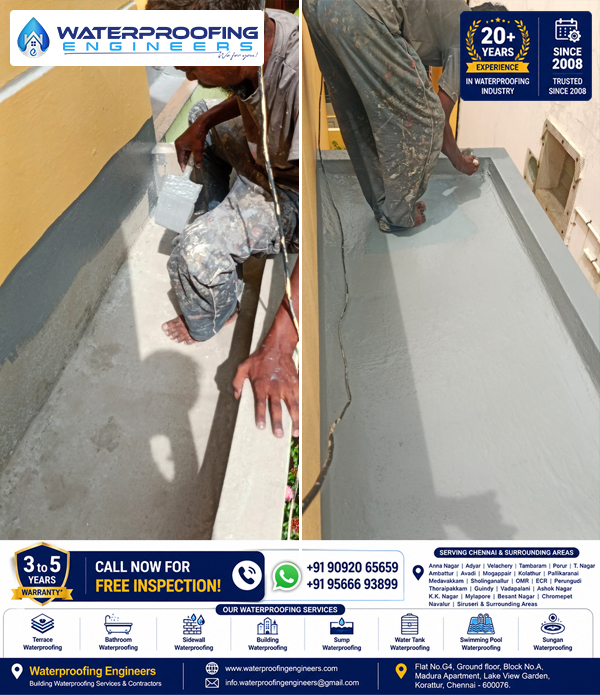
Water penetration is rarely just a surface problem. When rainwater repeatedly reaches vulnerable building surfaces, joints or terrace areas, the visible symptoms can eventually appear indoors as damp ceiling patches, peeling paint and recurring moisture.
In this Thoraipakkam Building Leakage Treatment Project, water penetration was noticed around exposed building surfaces and joints. The customer was also facing water seepage during rainy seasons, damp patches on ceilings and peeling interior paint.
Instead of treating only the visible interior symptoms, the approach was to inspect the affected areas, understand the likely water-entry points and develop a suitable waterproofing procedure.
The work involved terrace chemical waterproofing with Nonwoven Fiber Mat reinforcement, together with localized crack and joint treatment. The objective was to provide a renewed waterproofing layer and improve the building’s resistance to rainwater penetration.
Get Free Inspection – Waterproofing Engineers
Call for Inspection: If rainwater seepage, damp ceilings or peeling paint are appearing in your Thoraipakkam property, arrange an inspection before repeatedly repairing the interior surface.
Problem → Inspection → Diagnosis
The Leakage Problem
The customer reported recurring water-related problems during rainy weather. Water penetration was noticed around exposed building surfaces and joints, while the interior showed signs of moisture.
The main concerns included:
- Water seepage during rainy seasons
- Damp patches on interior ceilings
- Peeling or damaged interior paint
- Water penetration around vulnerable building surfaces
- Concern about recurring leakage
- Exposure of the building to heavy seasonal rainfall
The visible damp patch inside a building does not always indicate the exact point where water entered. Water can travel through concrete, joints and other building layers before becoming visible indoors.
That is why the inspection started from the exposed surfaces and terrace areas rather than treating the interior symptom alone.
Inspection
The terrace and relevant exposed building surfaces were examined to understand the condition of the waterproofing layer and vulnerable locations.
The inspection focused on:
- Surface condition
- Visible cracks
- Joints and junction areas
- Existing waterproofing condition
- Areas exposed directly to rainfall
- Possible water-entry pathways
- Preparation requirements before coating
The findings were explained to the customer in straightforward terms. The proposed procedure, expected stages of work and applicable warranty terms were discussed before the quotation was finalized.
Diagnosis
The project required targeted treatment of vulnerable areas rather than relying on a single surface coating without preparation.
The treatment therefore combined proper surface preparation, localized crack and joint treatment and a chemical waterproofing system reinforced with Nonwoven Fiber Mat.
For additional information about terrace-related leakage, see our Terrace Waterproofing Services.
“The visible damp patch is a symptom. The first job is to understand how water is reaching that area.”
Waterproofing Method → Execution
Chemical Waterproofing with Nonwoven Fiber Mat
For this project, the selected work was terrace chemical waterproofing using Nonwoven Fiber Mat reinforcement.
The system was planned around the inspected surface condition. The purpose was to establish a renewed waterproofing layer capable of providing improved resistance against rainwater penetration.
Surface Cleaning & Preparation
The work began with surface cleaning and preparation. Suitable preparation is an important part of waterproofing because coating performance depends on the condition of the substrate beneath it.
Loose or unsuitable surface material and other preparation issues need to be addressed before proceeding with the waterproofing application.
Crack and Joint Treatment
Localized cracks and joints were treated as part of the waterproofing process.
These areas deserve particular attention because movement, openings or deterioration around joints can create pathways for water. Treating them before the main coating helps the overall system address more than just the open surface.
Multiple Coating Layers
After preparation and localized treatment, multiple layers of suitable chemical waterproofing coating were applied with reinforcement Nonwoven Fiber Mat.
The general execution sequence included:
- Cleaning the affected terrace surface
- Preparing the substrate
- Identifying vulnerable areas
- Treating relevant cracks and joints
- Applying the specified chemical waterproofing coating
- Incorporating Nonwoven Fiber Mat reinforcement
- Applying subsequent coating layers
- Checking the completed waterproofing treatment
The exact material and number of coats should always be determined according to the site condition and manufacturer’s application requirements.
For properties requiring a different system, Waterproofing Engineers also provides Bitumen Waterproofing, PU Chemical Coating and Chemical Grouting.
WhatsApp Now / Contact Waterproofing Engineers
Call Now / WhatsApp: Discuss your building leakage problem and arrange an inspection so the appropriate waterproofing method can be evaluated for your property.
Result → Warranty
Renewed Waterproofing Protection
Following the treatment, the vulnerable building and terrace areas received renewed waterproofing protection.
The result was intended to improve the treated surfaces’ resistance to rainwater penetration and reduce the conditions contributing to recurring seepage.
The completed work included:
- Prepared and treated terrace surfaces
- Localized crack and joint treatment
- Chemical waterproofing coating
- Nonwoven Fiber Mat reinforcement
- Multiple waterproofing layers
- Attention to exposed vulnerable areas
The customer was happy with the quality of the work and the on-time completion.
The customer also provided a 5-star Google rating, as stated for this project.
It is important to understand that waterproofing performance depends on several factors, including the condition of the substrate, drainage, structural movement, joints, weather exposure and subsequent maintenance. No waterproofing system should be described as an absolute guarantee against every future source of moisture.
5-Year Warranty
For this project, a 5-year warranty was provided according to the agreed project terms.
The warranty should be read together with the quotation, specified treatment area and applicable conditions.
For other building moisture problems, customers can also explore Building Waterproofing Services and Sidewall Waterproofing Services.
Customer Experience & 10 FAQs
Customer Testimonial
⭐⭐⭐⭐⭐
One of the best companies for Building Waterproofing Services. They inspected our property thoroughly before suggesting the right solution. Their workmanship and attention to detail were impressive.
Frequently Asked Questions
1. What causes building leakage during rain?
Common causes can include cracks, joints, porous concrete, deteriorated waterproofing, drainage problems and vulnerable exposed surfaces. An inspection is needed to identify the likely source.
2. Can terrace leakage cause interior ceiling dampness?
Yes. Rainwater entering through a terrace or exposed surface can travel through building materials and appear as dampness on an interior ceiling.
3. Why should cracks be treated before waterproofing?
Open or vulnerable cracks can provide pathways for water. Treating suitable cracks before the main waterproofing layer helps address these vulnerable points.
4. What is Nonwoven Fiber Mat used for?
Nonwoven Fiber Mat can be incorporated as reinforcement within suitable waterproofing coating systems to support the waterproofing layer.
5. Is chemical waterproofing suitable for every building?
Not necessarily. The appropriate system depends on the substrate, leakage source, existing waterproofing, exposure and site condition.
6. Why is surface preparation important?
A clean and suitably prepared substrate helps the waterproofing coating achieve the required application and adhesion conditions.
7. Can interior painting solve building leakage?
Interior painting can improve appearance, but it does not necessarily address water entering from the terrace or exposed building surface.
8. How long does waterproofing work take?
The duration varies according to the area, surface condition, preparation, number of coating layers and weather or curing conditions.
9. Does this project include a warranty?
Yes. A 5-year warranty was provided for this project according to the agreed terms.
10. How can I determine the right waterproofing method?
A site inspection is the practical starting point. The waterproofing method can then be selected according to the actual source and condition of the leakage.
For more questions, visitors can refer to the Waterproofing Engineers FAQ page or browse the Waterproofing Engineers Blog.
Request a Quote for Thoraipakkam Building Waterproofing
If your Thoraipakkam property is experiencing rainwater seepage, terrace leakage, damp ceiling patches or peeling paint, repeated interior repairs may not address the source of the problem.
A proper inspection can help determine whether the issue is related to the terrace, joints, cracks, sidewall or another exposed building surface.
The inspection findings can then be explained clearly before the waterproofing procedure and quotation are finalized.
Request a Quote
Suggested enquiry message:
“I have water seepage and damp patches in my Thoraipakkam property during rainy weather. I would like to arrange a site inspection and receive a quotation for suitable building or terrace chemical waterproofing with Nonwoven Fiber Mat.”
Request a Quote – Contact Waterproofing Engineers
For additional guidance before requesting an inspection, explore the Waterproofing Engineers Blog, where terrace leakage, waterproofing methods and building moisture issues can be explained in greater detail.
Conclusion
The Thoraipakkam Building Leakage Treatment Project focused on understanding the water-entry problem and treating vulnerable exposed areas rather than concentrating only on the interior symptoms.
Through surface cleaning and preparation, localized crack and joint treatment, and multiple layers of chemical waterproofing reinforced with Nonwoven Fiber Mat, the affected areas received renewed waterproofing protection.
The customer was satisfied with the quality and timely completion, with a 5-star Google rating provided after the project.
Thoraipakkam Building Waterproofing — Find the Water Path. Treat the Surface. Strengthen the Protection.